
More Pembroke news

‘Artificial Speech Acts’: Revd Dr Oliver Wright on communication between Humans and AI
NEWS |
Earlier this Spring, Pembroke JRF Revd Dr Oliver Wright, part of the Religion and the Frontier Challenges postdoctoral research programme, spoke at a conference on AI hosted by Boston College. The conference theme, ‘Machine Logos: Persons, Language and AI’, offered Dr Wright the opportunity to explore the complex philosophical issues that arise from communication between humans and AI chatbots.
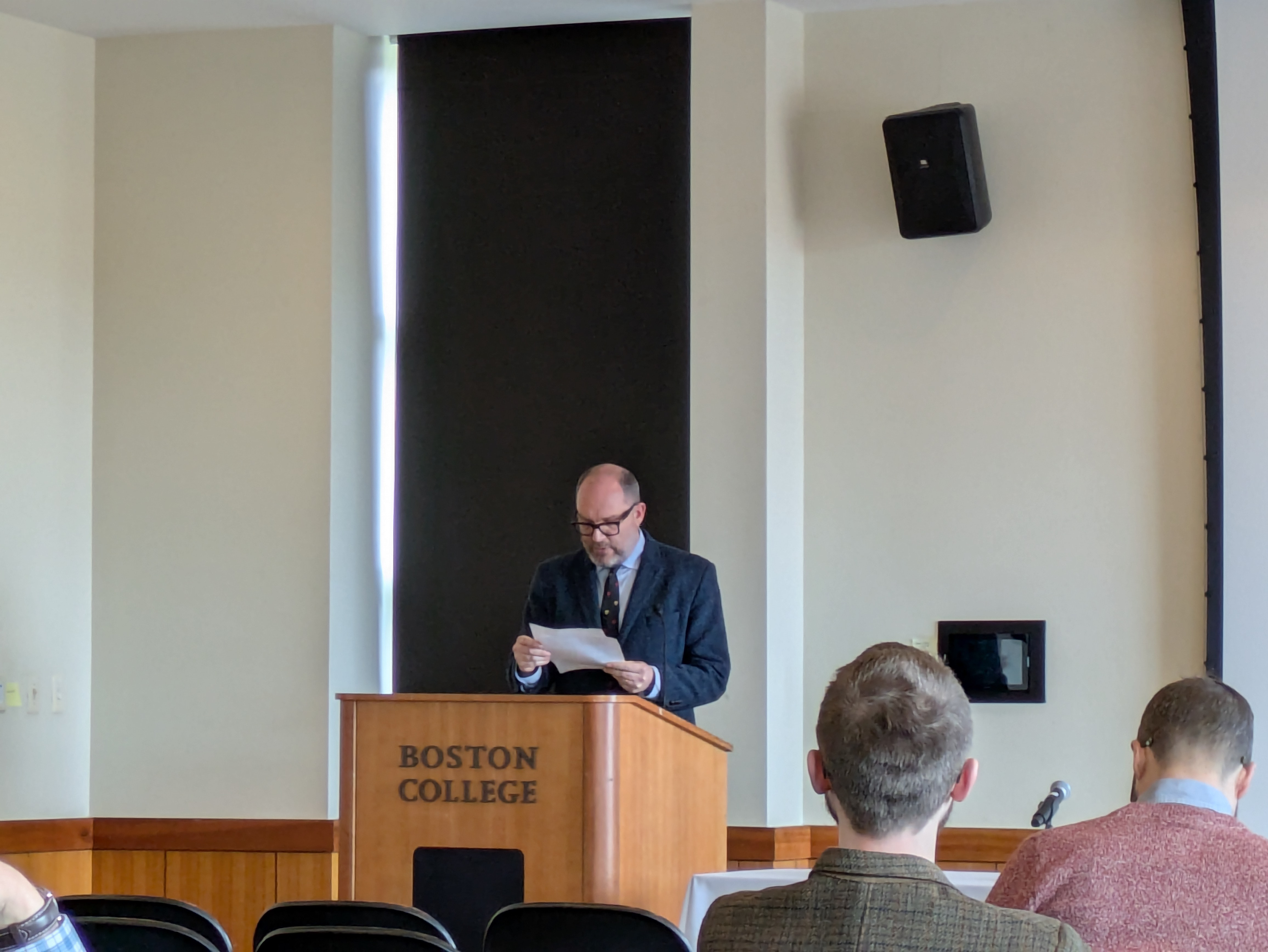
Wright’s principal interlocutor is Oxford philosopher J.L. Austin, and his concept of a speech act, an utterance which performs an action in a social context. In one important and basic sense, there are no such speech acts in Large Language Models, which lack any social context and importantly are built from a system which assumes the existence of no such acts either. In these mass-prediction machines, words are allocated mathematical tokens according to their value in language, and not according to the unique value of a particular linguistic act in a particular social situation.
One of the outcomes of this argument is that there can be none of the ‘reaching-in-language’ inherent to human speech, that is the failure to find the right words and right effects of words.
However, in one other more pernicious sense, there is a form of speech acts in LLMs, that is their perlocutionary effect. Although an LLM does not itself have a social context, and cannot act due to its construction, its words are nevertheless read and received in a social context – in a human context. The concern is that unlike humans, LLMs can have ‘real-world impacts with no real-world responsibility’.
“The LLM has abstracted human words with human speech act potential, treated them in the atomising process of tokenisation as if there were no such multifarious acts, and then strung them together, adding a pinch of reinforcement learning for seasoning,” shares Wright. “It should perhaps not surprise us that a vestige of the inherent acts in human words remains after this token-washing. This is one way to explain real-world impacts with no real-world responsibility.”
Wright concluded his talk with a ‘quixotic’ call to action: to embrace the failure of human speech, “when a human reaches imprecisely for something in language”. Afterall, the beauty of language is that “it lives and breathes”.
You can read Wright’s full talk here.