
More Pembroke news


The future of malaria vaccines: new study discovers how antibodies block malaria parasite growth
NEWS |
In an important discovery for the next generation of malaria vaccines, Pembroke Lecturer Dr Barney Williams and other Oxford researchers have identified how antibodies can be over 90% effective at preventing malaria parasites from growing.
Malaria remains one of the deadliest diseases in low-income countries. In 2024 it killed more than 600,000 people, mainly young African children. While two vaccines are already recommended by the World Health Organisation, they target the earlier liver-stage of infection. This new research, published in Immunity, will support the development of new vaccines as a second line of defence and to stop the parasite once it reaches red blood cells, where the illness occurs.
One potential target of a new vaccine is a malaria protein called “RIPR”, which plays a critical role in the parasite’s invasion of human red blood cells. Analysing 83 vaccine-induced human monoclonal antibodies (mAbs) against the RIPR protein, the lab study showed that single mAbs did not block parasite growth on their own. However, through ‘team’ attacks on different parts of the RIPR protein’s ‘tail’, combinations of mAbs were over 90% effective at limiting parasite growth.
Dr Barney Williams, who is also Senior Postdoctoral Research Associate in the Draper Lab and senior author of the study, explained: "Most vaccine research has focused on identifying individual antibodies that can strongly neutralise a pathogen. What we found here is different: the strongest protection comes from antibodies working together in a coordinated way."
Giving a more complete picture of the RIPR structure, the study shows clearer images of the hard-to-see and highly dynamic ‘tail’ of the protein. The researchers found that this usually flexible tail is stiffened when antibodies work together. This in turn exposes usually hidden areas of the tail and allows antibodies to bind to these, disarming the parasite’s invasion mechanism.
Dr Williams added: "Our work shows that effective protection against malaria can emerge from cooperation between antibodies. By understanding these interactions, we can begin designing vaccines that deliberately generate the most effective combinations of immune responses."
Read more about the study here.
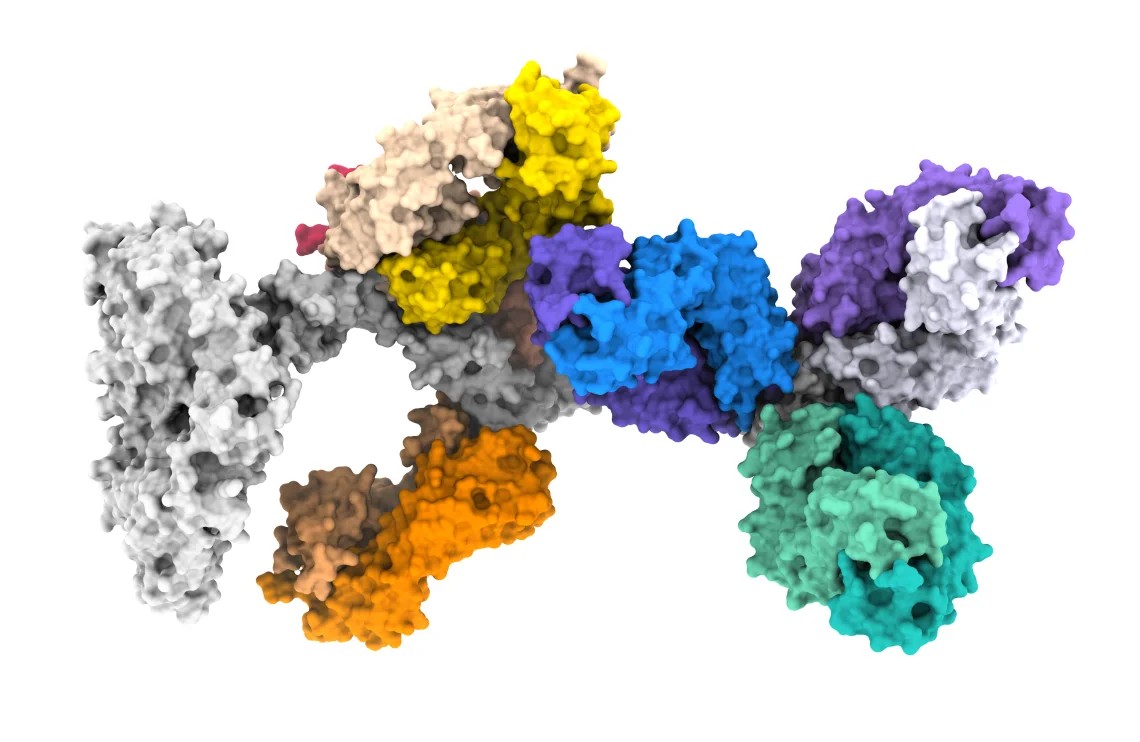
Above is a graphic image of the RIPR structure. RIPR stands for RH5-Interacting Protein. It is expressed by Plasmodium faliciparum, the parasite responsible for the most sever form of malaria, and plays a critical role in the parasite’s invasion of human red blood cells. Mechanistically, RIPR forms part of an essential protein complex on the merozoite (the blood-stage form of the parasite), together with RH5 (Reticulocyte-binding protein Homologue 5) and CyRPA (Cysteine-rich Protective Antigen).