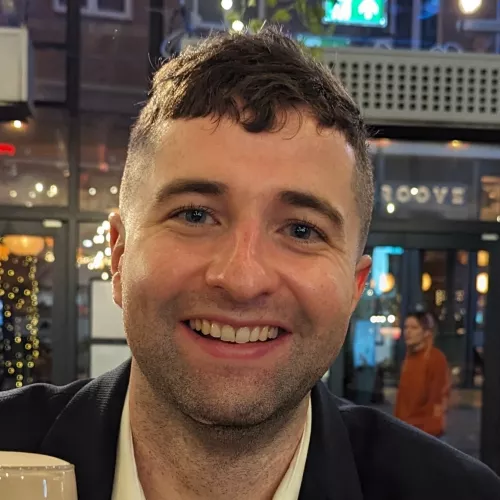
Dr Michael Livesey
My research explores the history of UK security politics during the Northern Ireland ‘Troubles’.
The Troubles saw important shifts in the UK’s domestic and international security paradigms. On one hand, these years saw the development of novel peacebuilding strategies leading to the signing of the Good Friday Agreement. On the other, the Troubles also saw the emergence of the UK’s first ever ‘counter-terrorism’ laws, granting Government new powers of stop-and-search, proscription, detention without charge, and non-jury trial for terrorist suspects. Today, these powers represent a major feature of both everyday domestic security practice, and resistance to it – as seen in recent debates around the proscription of Palestine Action and detention of pro-Palestine activists. However, they all originated in the UK Government’s campaign to end Troubles violence.
My research explores conditions of possibility for the emergence of contemporary counter-terrorism and peacebuilding paradigms, over these years of Troubles violence. I’m interested to understand how these new security policies fit, within wider patterns of British politics on Ireland and Northern Ireland over the longue durée. In my research, I use digital humanities methods to trace patterns of British political discourse on Northern Ireland since 1920 (as well as Ireland generally, before partition). And I use qualitative archival and interview methods to establish intersections between these long-term patterns, on one hand, and principles informing Troubles-era security policy, on the other.
I have published my research via several articles in journals like the European Journal of International Relations, the European Journal of International Security, and Review of International Studies. And I have a book which is due to be published by Bloomsbury in 2027. I have also shared my work outside academia, via a series of public research exhibitions organised with museum partners in Yorkshire and Kent. Through these exhibitions, I have brought my findings to a wider audience, including over 33,000 exhibition viewers.
At Pembroke College, I am part of the Writing Peace project, which uses digital humanities methods to model negotiations comprising Northern Ireland’s peace process. My research for Writing Peace considers the Northern Ireland peace process’ international context. This includes tracing the careers of British and Irish diplomats who were involved in talks in Northern Ireland: to see where they gained experience prior to those talks, and where they reapplied it afterwards. Alongside this research, I am writing an ebook on the Northern Ireland peace process, which is designed for use in schools.
I studied a BA in History at the University of Oxford, an MSc in International Relations at the London School of Economics, and a PhD in Politics at the University of Sheffield.
Before beginning my PhD, I worked outside academia. From 2017 to 2021, I worked in the UK Parliament as a Parliamentary Researcher, Senior Caseworker, and Constituency Support Officer. Prior to that, I worked as a secondary school teacher (teaching History and Politics). My non-academic career has shaped my research, including vis-à-vis the archival sources I use in my scholarship, as well as my interest in schools outreach.
You can read more about my research and background at my website: www.mlivesey.org.
2026-present: Junior Research Fellow, University of Oxford.
2025-present: Visiting Research Fellow, King’s College London.
2024-2025: ESRC Postdoctoral Fellow, University of Sheffield.
2021-2024: Teaching Associate, University of Sheffield.
2023: Visiting Scholar, University of Otago.
2022: Visiting Scholar, Queen’s University Belfast.
2021-2023: Research Assistant, University of York.
2020-2023: PhD Candidate, University of Sheffield.
2017-2021: Parliamentary Researcher & Senior Caseworker, UK Parliament.
Forthcoming book: Deep Roots, Poisoned Soil: A History of UK Security Politics in Northern Ireland (under contract for publication with Bloomsbury in 2027).
‘Measurement = generative: bridging IR’s epistemological divides with quantum mechanics’ measurement apparatus’, European Journal of International Relations (2025). https://doi.org/10.1177/13540661251388529.
‘To look for another thing, and in another way: revitalising criticality with multimodal methodologies’, Critical Studies on Terrorism (2024). https://doi.org/10.1080/17539153.2024.2370612.
‘Armed group formation in civil war: “movement”, “insurgent”, and “state splinter” origins’, Review of International Studies (2024). http://doi.org/10.1017/S0260210524000020.
‘Introducing the “conceptual archive”: a genealogy of counterterrorism in 1970s Britain’, European Journal of International Security (2023). http://doi.org/10.1017/eis.2023.10.
‘The ring cycle: journeying through the language of Tolkien’s Third Age with corpus linguistics’, Journal of Tolkien Research (2023). https://scholar.valpo.edu/journaloftolkienresearch/vol18/iss1/4.
‘Historicising “terrorism”: how, and why?’, Critical Studies on Terrorism (2021). https://doi.org/10.1080/17539153.2021.1982467.
Dr Michael Livesey
My research explores the history of UK security politics during the Northern Ireland ‘Troubles’.
The Troubles saw important shifts in the UK’s domestic and international security paradigms. On one hand, these years saw the development of novel peacebuilding strategies leading to the signing of the Good Friday Agreement. On the other, the Troubles also saw the emergence of the UK’s first ever ‘counter-terrorism’ laws, granting Government new powers of stop-and-search, proscription, detention without charge, and non-jury trial for terrorist suspects. Today, these powers represent a major feature of both everyday domestic security practice, and resistance to it – as seen in recent debates around the proscription of Palestine Action and detention of pro-Palestine activists. However, they all originated in the UK Government’s campaign to end Troubles violence.
My research explores conditions of possibility for the emergence of contemporary counter-terrorism and peacebuilding paradigms, over these years of Troubles violence. I’m interested to understand how these new security policies fit, within wider patterns of British politics on Ireland and Northern Ireland over the longue durée. In my research, I use digital humanities methods to trace patterns of British political discourse on Northern Ireland since 1920 (as well as Ireland generally, before partition). And I use qualitative archival and interview methods to establish intersections between these long-term patterns, on one hand, and principles informing Troubles-era security policy, on the other.
I have published my research via several articles in journals like the European Journal of International Relations, the European Journal of International Security, and Review of International Studies. And I have a book which is due to be published by Bloomsbury in 2027. I have also shared my work outside academia, via a series of public research exhibitions organised with museum partners in Yorkshire and Kent. Through these exhibitions, I have brought my findings to a wider audience, including over 33,000 exhibition viewers.
At Pembroke College, I am part of the Writing Peace project, which uses digital humanities methods to model negotiations comprising Northern Ireland’s peace process. My research for Writing Peace considers the Northern Ireland peace process’ international context. This includes tracing the careers of British and Irish diplomats who were involved in talks in Northern Ireland: to see where they gained experience prior to those talks, and where they reapplied it afterwards. Alongside this research, I am writing an ebook on the Northern Ireland peace process, which is designed for use in schools.
I studied a BA in History at the University of Oxford, an MSc in International Relations at the London School of Economics, and a PhD in Politics at the University of Sheffield.
Before beginning my PhD, I worked outside academia. From 2017 to 2021, I worked in the UK Parliament as a Parliamentary Researcher, Senior Caseworker, and Constituency Support Officer. Prior to that, I worked as a secondary school teacher (teaching History and Politics). My non-academic career has shaped my research, including vis-à-vis the archival sources I use in my scholarship, as well as my interest in schools outreach.
You can read more about my research and background at my website: www.mlivesey.org.
2026-present: Junior Research Fellow, University of Oxford.
2025-present: Visiting Research Fellow, King’s College London.
2024-2025: ESRC Postdoctoral Fellow, University of Sheffield.
2021-2024: Teaching Associate, University of Sheffield.
2023: Visiting Scholar, University of Otago.
2022: Visiting Scholar, Queen’s University Belfast.
2021-2023: Research Assistant, University of York.
2020-2023: PhD Candidate, University of Sheffield.
2017-2021: Parliamentary Researcher & Senior Caseworker, UK Parliament.
Forthcoming book: Deep Roots, Poisoned Soil: A History of UK Security Politics in Northern Ireland (under contract for publication with Bloomsbury in 2027).
‘Measurement = generative: bridging IR’s epistemological divides with quantum mechanics’ measurement apparatus’, European Journal of International Relations (2025). https://doi.org/10.1177/13540661251388529.
‘To look for another thing, and in another way: revitalising criticality with multimodal methodologies’, Critical Studies on Terrorism (2024). https://doi.org/10.1080/17539153.2024.2370612.
‘Armed group formation in civil war: “movement”, “insurgent”, and “state splinter” origins’, Review of International Studies (2024). http://doi.org/10.1017/S0260210524000020.
‘Introducing the “conceptual archive”: a genealogy of counterterrorism in 1970s Britain’, European Journal of International Security (2023). http://doi.org/10.1017/eis.2023.10.
‘The ring cycle: journeying through the language of Tolkien’s Third Age with corpus linguistics’, Journal of Tolkien Research (2023). https://scholar.valpo.edu/journaloftolkienresearch/vol18/iss1/4.
‘Historicising “terrorism”: how, and why?’, Critical Studies on Terrorism (2021). https://doi.org/10.1080/17539153.2021.1982467.