
More Pembroke news

What does Physics have to do with Philosophy?
NEWS |
“What does physics have to do with philosophy? It’s a question I often have to contend with at Open Days. But it seems to me pretty obvious that they're after the same kind of thing: understanding the nature of reality and not merely using physics as an instrumental tool or doing philosophy without any knowledge of all of the things that we've learned about the world via physics or the sciences in the past hundreds or thousands of years."
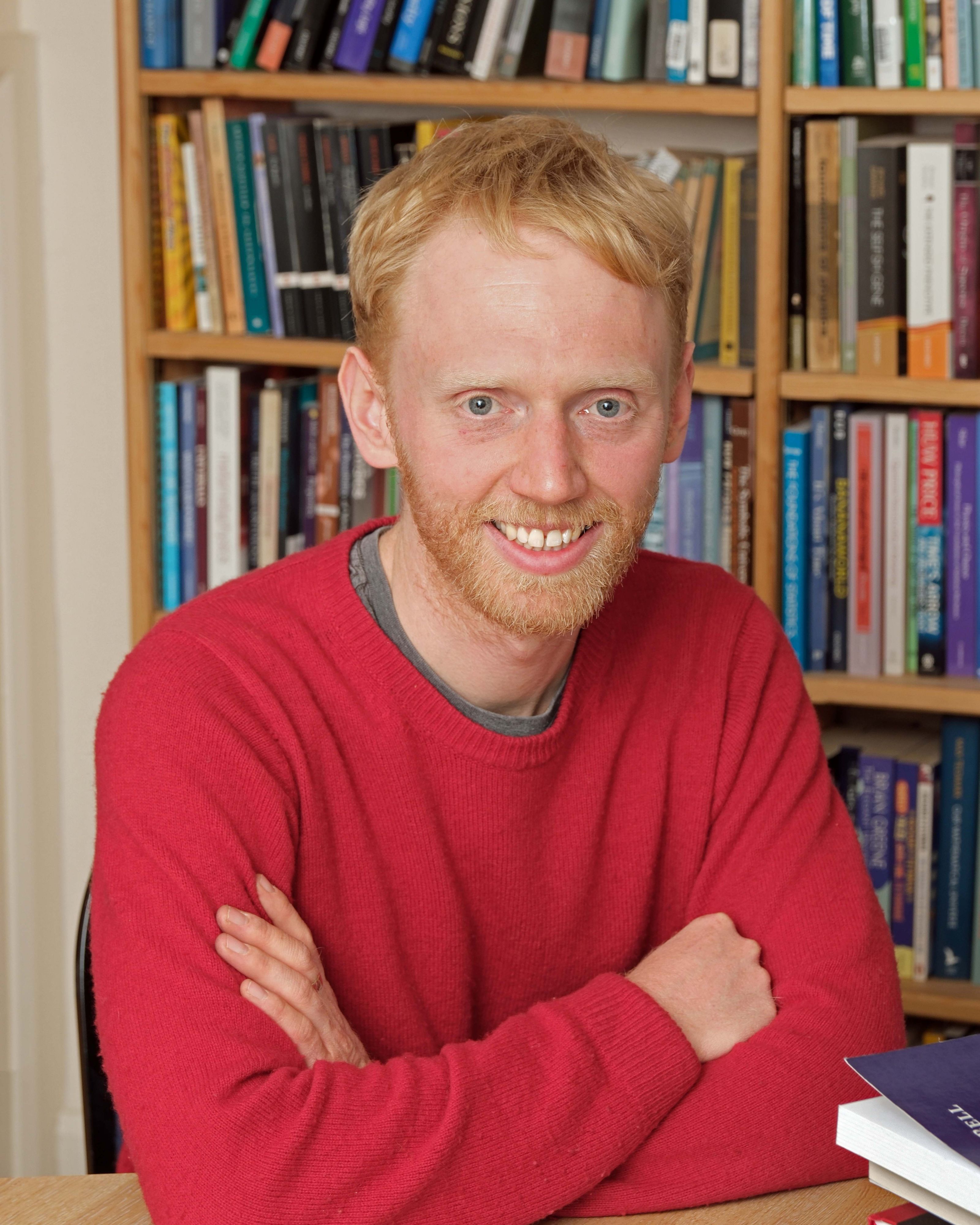
Pembroke Profile: Professor James Read
When we speak, Professor Read is preparing for a year of research and writing made possible by a prestigious British Academy Mid-Career Fellowship. Alongside a popular book on Physics, he plans a second, more specialist volume, entitled: “The inevitability of general relativity: derivations, principles, and consilience.”
I make it very clear at the start of our conversation that there are pottos creeping through the forests of Angola with a superior grasp of basic maths and physics than me. He smiles confidently. Teaching his subject to audiences who don’t necessarily have much background knowledge is something he does a lot, he explains.
“I’ve been doing these lifelong learning courses in the Department for Continuing Education for people – often retired people – who just want to learn about physics and maths. It involves explaining some of the more unexpected and surprising consequences of various fields of physics to people with almost no mathematics or physics background, so I’m confident it can be done. For example, a lot of the more striking aspects of special relativity can be explained with at most Pythagoras’ theorem. And I think most people can get their head around that.”
Noticing my smile grow waxen, he quickly adds: “Even then, you don’t need to actually do any computations with the theorem. It’s just a guide for understanding, say, why clocks run slowly when set in motion.”
Actually, there are plenty of reasons to trust his ability to make such dauntingly recondite subjects approachable by the uninitiated. He is surprised and perhaps a little alarmed when informed that I spent some of the previous evening watching a lecture he had given two years before (“An invitation to constructive axiomatics”) with interest if not total (or perhaps even partial) comprehension.
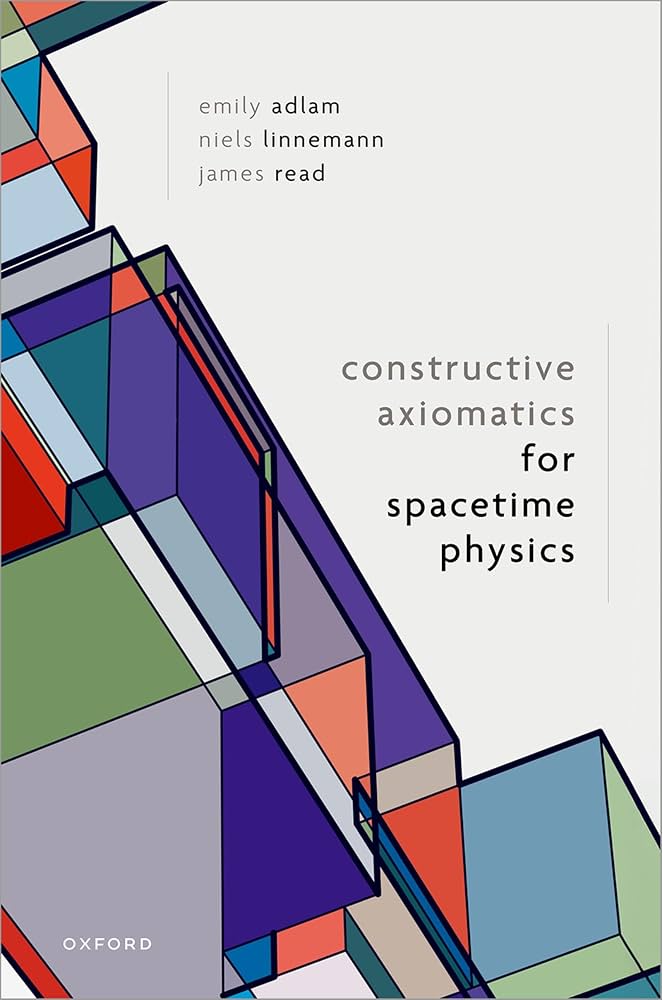
This was based on Professor Read’s most recent book, “Constructive Axiomatics for Spacetime Physics” – his fourth, alongside over 70 research articles in leading journals, which, given his youth, suggests he began publishing as an embryo.
“I am self-motivated,” he admits almost apologetically. Later he names ‘The Rider’ by Tim Krabbe as a book he particular “vibes with” – it is a 100-page semi-autobiographical novel about the relentless pursuit of being your best self through agonising adversity.
“In Primary School I was a very average student but, and I don’t know why, something switched in my mind when I was about 12. I started getting homework, and started asking myself, “Is this the best piece of work I can do or can I improve it?, and that’s never really stopped since then.”
The son of a submariner father and librarian/gardener mother who were supportive but unconcerned with academic success and student at a school that was neither bad nor particularly good, he feels this self-motivation drove his scholarly success.
“And, honestly, I think that’s probably true for a lot of state school kids who end up at Oxbridge. They have to push themselves.”
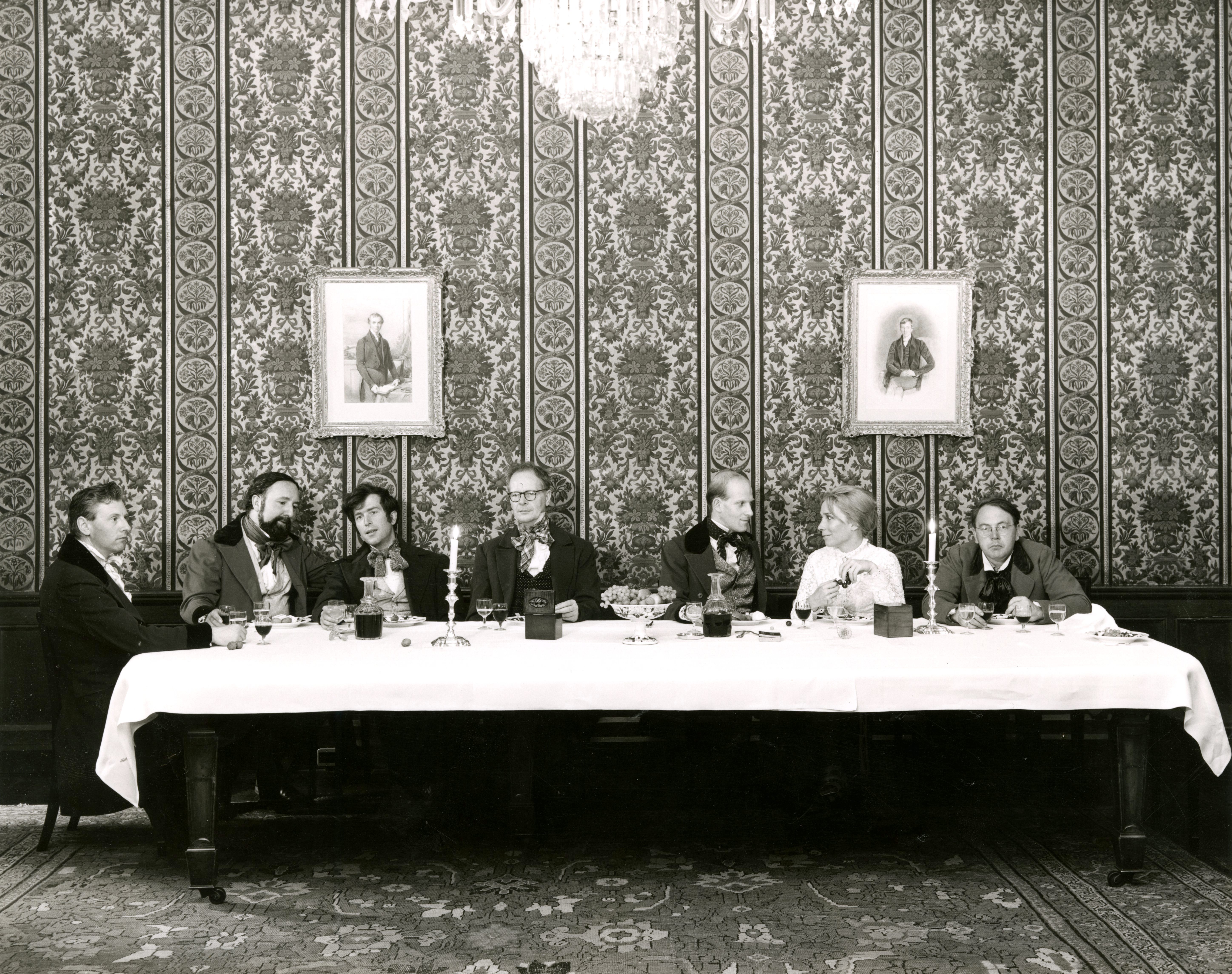
Pembroke Fellows at dinner in Keble College, re-enacting the age of George Eliot; third from left: Simon Blackburn (credit: Studio Edmark)
Having got into Philosophy at 16 after reading ‘Think’ by Simon Blackburn (prophetically a former Fellow at Pembroke), he studied Physics and Philosophy at Oriel College before completing a Maths degree at Cambridge, then returned to Oxford for graduate studies. By then he realised his interest lay in the philosophy of physics rather than theoretical physics, “because it gave me a bit more flexibility to do mathematics and physics but also to pursue my interests in the humanities; to write for its own sake.”
When his supervisor retired five positions opened, one of which was at Pembroke. Though still a graduate student, he threw his hat into the ring safe in the knowledge it was not his only hat.
“It was a long shot, but in a way that led me to being more relaxed through the process. And everything went very well.”
He was offered the job and, at 26, became Associate Professor and Tutorial Fellow in Philosophy at Pembroke College.
Looking back, he feels his teaching experience worked in his favour.
“I’d been teaching something like 12 hours a week every term for two years because it was fun and a good way of learning other areas of philosophy, but that’s more than I do now.”
Was he a sort of Swiss Army knife of an academic, able to be deployed in maths, physics, and philosophy?
“I think so...And it’s one of the things we get trained to do quite well as associate professors and tutorial fellows at Oxford – pitching to people at different levels and always being aware of their background knowledge. I think that carries over to engagement with high school students, too.”
This helps explain the motivation behind the planned accessible introduction to the philosophy of physics and the reason Professor Read is so perfectly equipped to produce it.
“In my opinion, the teachers who are not good teachers are those who don’t know the material that well or as well as they think they do. I feel that if you really understand something, you can condense it down to its essential features and convey that to audiences even who don’t necessarily have a tremendous amount of background knowledge.”
These skills have been honed not only by his university teaching and the courses run in the Department for Continuing Education but by facing the devastatingly straightforward questions posed by his five-year-old son.
“I try to hold myself to high standards. He asked me, ‘why is water clear?’ Well, turns out you need quantum field theory to answer this. But even if I can’t give him an answer straight away, I try to push things so that I understand the answer afterwards.”
The aims of the popular introduction to physics are simple but rather cunning.
“My ambition is to pitch to my 17-year-old self; to take 15 of the juiciest areas of the philosophy of physics – interpretations of quantum mechanics, the nature of entropy and disorder, and so on – and dive into them. My other aim is to have something which would be helpful from the point of view of recruitment to the Physics and Philosophy undergraduate degree.”
There are many reasons to apply to Oxford to study Physics and Philosophy, not least the presence of academics such as Professor Read at the Faculty. Oxford is fortunate to have around 10 professional philosophers of physics: by far the largest concentration at any University in the world. As such, the quality of the teaching is both exceptionally broad and deep. Given this, it’s little wonder that the Physics and Philosophy degree is such a competitive course, with only around 12% of applications accepted.
When I explain that having to master both Physics and Philosophy in school strikes me as like being asked to fashion origami dragons while paragliding through gunfire, Professor Read is sympathetic but rational.
“In the admissions process we have tests for ability in Mathematics and Physics; not so for Philosophy,” he explains. “Philosophy is kind of topic neutral – you can study the philosophy of a range of disciplines – and we never assume people have studied it. But all Philosophy is founded on systematic logical reasoning and in interviews that is what I’m trying to assess. So, I may give you a sentence like, ‘Stephen goes to the shops only if he buys tomatoes.’ Now, is buying tomatoes necessary or sufficient for Stephen’s going to the shops?”
After a long silence he continues:
“There are questions you can get wrong if you don’t think carefully, but thinking carefully is what a philosopher should do. I want to see applicants navigate tricky situations which they might not have seen before, because that is what we do in the subject all the time.”
A natural communicator with a flair for blowing the proverbial dust from a subject to reveal the diamantine sparkle beneath, Professor Read is perfectly qualified for the project he has set himself. I realise during our conversation that he even manages to make someone whose memories of Physics in secondary school provoke instinctive retching and the need for a prolonged nap feel a throb of excitement about the subject. He looks back to the very philosophically-minded school of Physics from which Einstein emerged.
“He incorporated philosophical principles (like Mach’s principle) which basically says that there can’t be a change in space-time without a corresponding change in matter. This is very closely related to the ultimate insight of the Einstein equations. All these physics/philosophy principles ended up leading him to the theory of general relativity. It’s so striking that there’s so much philosophy there. He had long correspondences and friendships with the leading philosophers of the day, all of which one doesn’t really appreciate when one just learns general relativity in a textbook.”
The theory of general relativity serves as the doorway into the second (more significant) project he has planned: “The inevitability of general relativity: derivations, principles, and consilience.”
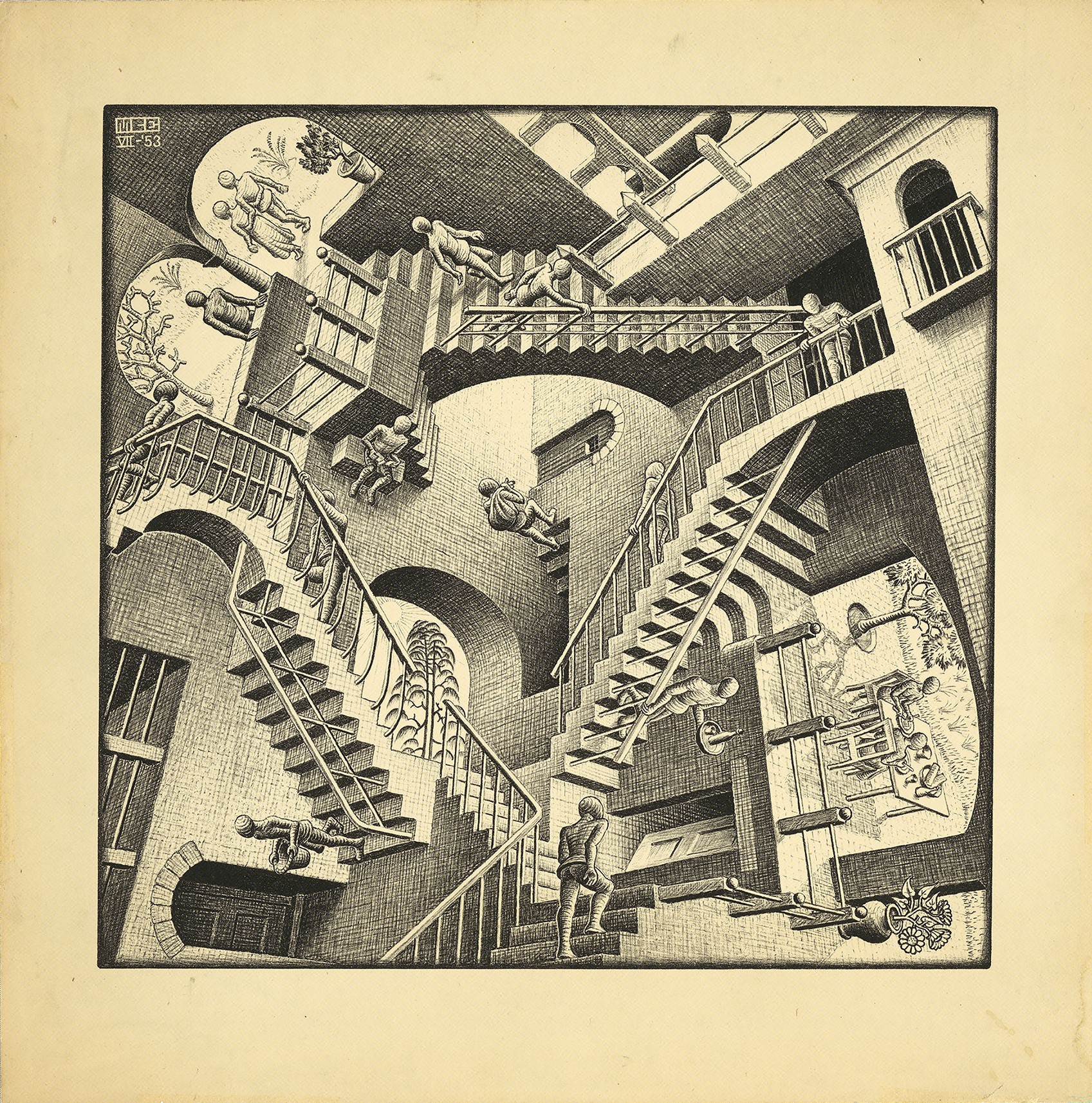
M.C. Escher, Relativity, 1953
“Since 1915 our best theory of space and time and gravity and the cosmos has been Einstein’s general relativity, which has gone on to be developed in lots of extremely fruitful directions. Shortly after Einstein’s presentation of the theory, people started applying it to physical cosmology and thinking about the evolution of the universe which eventually led to big bang models and so on. People realised that it predicts black holes and singularities and gravitational waves, many of which have been detected in other ways by now. Therefore, general relativity is incredibly well confirmed empirically and one of the cornerstones of modern physics. And at the centre of general relativity are Einstein’s equations of the theory which say something pretty simple.”
Do they?
“To quote John Wheeler, ‘space-time tells matter how to move and matter tells space-time how to curve.’ In other words, they correct the Newtonian idea that matter, like bodies, are moved by gravitational force; rather they just move because they’re in a curved space-time geometry.”
Professor Read identifies that in the past century there have been about 50 derivations of Einstein’s field equations from vastly different areas of physics.
“There are very interesting thermodynamic arguments for Einstein’s field equations; there are arguments from high energy physics; there are arguments from an electromagnetic angle…Choose any other area of physics that you’re interested in and you seem to be able to arrive at Einstein’s field equations, which presents a lot of conceptional questions: are all of these different derivations of Einstein’s equations of the theory of general relativity the same or are the ways in which people are arriving at from starting point A, starting point B, starting point C, etc, different?
“I want to explore systematically how these different routes to general relativity compare with each other but also examine the more philosophical question: in what sense is this theory of space and time inevitable?”
Because wherever you start you get to Einstein’s theory?
“Exactly. I want to investigate whether the degree of consilience between this theory and other areas of physics indicate it is inevitable.”
The beauty of the project is that it aims to be both practical and interesting (a rare combination), a useful resource to physicists showing how these derivations work and compare to each other, and a particularly succulent philosophical question on the nature of a key concept in the philosophy of physics.
Professor Read is heartened about the prospects for the kind of research that he does by his high opinion of the students he meets at Open Days, interviews, and those on-course at Oxford. He is refreshingly positive about the state of secondary education in the UK.
“We do still have some academic standards. I mean, I think A-levels are still good internationally. And Oxford is a particularly extreme example where we push people to perform and the exams we set are objectively hard.”
A moment of particular pride came recently when the Philosophy undergraduates, having complained for several years that the first-year logic exam was too difficult, were told by the University that they would update the syllabus; this ended up being “about four times harder.”
Realism limits his optimism, however.
“The bad side is there’s no money. And I think it’s increasingly going back to some 19th-century system of benefaction whereby only wealthy gentleman scholars can pursue graduate studies, because there’s almost nothing available. This is particularly acute in the Arts and Humanities. I have brilliant people applying and being made offers but they don’t come because they don’t have the money to pursue graduate studies. Then, they’ll either leave academia or go somewhere else.”
It’s a general issue, I say, thinking how many UK Universities are running deficits and may cease to exist in the next decade.
He nods, sad but undefeated.
“Whether we can continue to be a world-leading country or world-leading university in research is very unclear to me if we’re unable to recruit the best people. That does make me worry.”
But as I leave our conversation, I am not despairing: the enthusiasm and energy of academics like Professor Read are what make Oxford extraordinary. Only slowly will that fade. Certainly slower than my understanding of Pythagoras’ theorem.