
More Pembroke news
3CR Talks: On Intimate Interracial Relationships and the American Anti-Miscegenation Regime, 1940-50
NEWS |
Student Benoit Mes started his academic journey completing a BA in History here at Pembroke in 2024. He is currently doing his MPhil in US History, expanding on his undergraduate research. Below he shares insights from his undergraduate thesis titled ‘Before Loving: Intimate Interracial Relationships and the American Anti-Miscegenation Regime, 1940-50’, which he presented as a 3CR talk to members of the College community. Our 3CR Talks programme offers our academics and students, whether in the JCR, MCR, or SCR, the opportunity to share their research with each other.
Before Loving: On Intimate Interracial Relationships and the American Anti-Miscegenation Regime, 1940-50
By Benoit Mes
Loving v. Virginia was the landmark US Supreme Court case which in 1967 declared that restrictions on interracial marriage were unconstitutional. The case brought down the last pillar of formal, legalised racial segregation and also marked the end of Richard and Mildred Loving’s near decade-long battle to live together freely as husband and wife. However, ten years prior to the Lovings’ initial arrest in 1958 and nearly twenty years before the landmark legal decision bearing their name, restrictions on interracial marriage in California had been successfully challenged by Andrea Perez and Sylvester Davis Jr.
In Perez v. Sharp (1948), the California State Supreme Court became the first court to rule that anti-miscegenation laws violated the US Constitution. And while the Perez case was not appealed to the US Supreme Court and thus did not establish a national standard, it did nonetheless mark how, long before Loving and the height of the US Civil Rights Movement in the 1960s, the regulation of interracial relationships was challenged. Historiography's focus on the Loving case, important though it is in the history of interracial relationships and marriage in the US, has somewhat obscured the stories of other interracial couples and a longer history of resistance to anti-miscegenation statutes. My undergraduate research sought to acknowledge and highlight some of these stories.
War
The Second World War was a critical moment for those committed to racial equality and the Black freedom struggle. The conflict was as much a battle internally as it was externally, with many criticising the tension at the heart of US society, that while Black soldiers fought to uphold ideals of freedom and democracy abroad, they faced at home and in the military racial segregation and discrimination.
Many soldiers stationed across Europe during and in the immediate aftermath of the war fell in love with local women. While white soldiers faced few obstacles in obtaining permission from the military to marry their war brides, Black soldiers found that their requests to marry white women were continually denied.
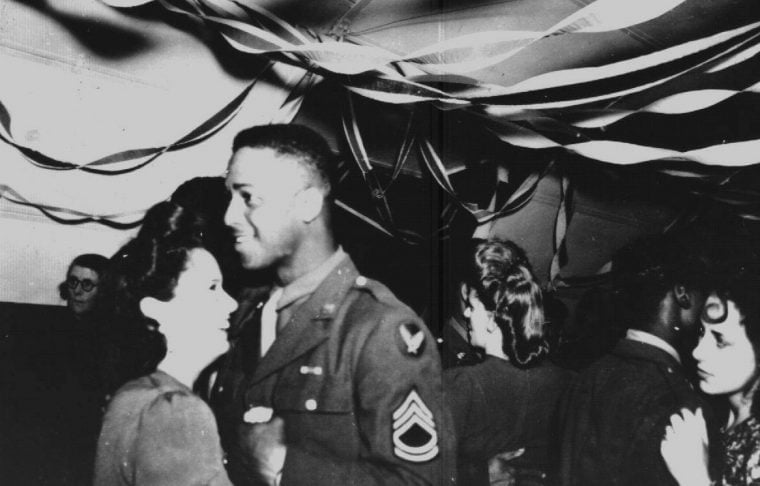
Photo credit: Gregory S. Cooke collection
One such story made the front page of the Chicago Defender; an anonymous serviceman was denied his marriage request despite multiple appeals. The military cite ‘public policy’ as the reason for denial, but there was no such federal or national law. NAACP (National Association for the Advancement of Coloured People) records also show a wider investigation where the Secretary of the Navy and Secretary of War were outright questioned on the subject. Both denied the existence of any military policy on interracial relationships. However, reports continued to flood in, with the nebulous phrase ‘public policy’ continually used, pointing to the existence of an uncodified yet widespread policy.
The Black Press reports how, mirroring this policy, white soldiers actively discouraged European women from entering relationships with Black servicemen, attempting to prevent interracial marriages. Opposition to interracial marriage was deeply entrenched in the period, whether codified or not. Yet, active challenges were brewing...
Law
Laws regulating interracial marriage had existed in America since before the foundation of the United States and were central to racial segregation.
By 1940, interracial marriage was illegal in 30 of America’s 48 states, with the laws blanketing especially the South and West. Laws generally denied marriage licenses but there were numerous state-to-state variations, with some making interracial intimacy and cohabitation a felony punishable through fines and jail time.
However, changing conditions in the 1940s exposed weaknesses in the anti-miscegenation regime and facilitated legal challenges. The period saw the peak of the NAACP, with the organisation growing from a c.50,000 member New York-based lobbying group to a national organisation with over 1,000 branches and membership peaking at 400,000 in the second half of the decade. The NAACP also founded its Legal Defence and Education Fund under Thurgood Marshall in 1940. The ACLU (American Civil Liberties Union) had grown significantly since its establishment in 1920 and in the 1930s, it expanded its programme to focus significantly on the rights of African Americans. Both organisations achieved major legal victories on racial discrimination in jury selection, graduate education, and the electoral primary system, to name a few.
There was also a fundamental shift in ideas around race in this period. Biological essentialism, scientific racism, and eugenics’ race science were increasingly rejected and undermined, while social construction became more widely accepted. At the same time, the newly formed United Nations, drawing on some of these shifts and on the Second World War, had a charter and declarations which advocated for fundamental human rights and freedoms irrespective of race, including around marriage.
In 1948 we see the first crack in the system with Perez v. Sharp – a case followed closely by the NAACP and ACLU. Andrea Perez and Sylvester Davis Jr.’s legal team successfully challenged the constitutionality of California’s anti-miscegenation statute. In their ruling, the judges in the majority specifically argued that anti-miscegenation laws contradicted America’s founding principles, but also cited the irrationality of racial categorisation and pointed to the recently adopted UN Charter. However, despite this success it would not be until Loving that the majority of anti-miscegenation laws would fall.
Another two cases, one in Mississippi and another in Virginia, demonstrate the effects of these changing conditions on legal challenges to anti-miscegenation statutes. Both cases involved the questioning of the racial identity of one person in the marriage, and both made headlines nationally, though neither led to state or national change in the law. The cases demonstrated the difficulties in the regulation of interracial relationships, exposing weaknesses beyond the law in the anti-miscegenation regime.
The NAACP LDF and ACLU made continued efforts to dismantle this aspect of segregation, offering support in such cases. It was often the organisations' members who brought cases to their attention, and, as such, the constant search for a viable constitutional test case on the issue was facilitated by the growth of these organisations administratively and in membership, popularity, and reach.
Celebrity
The 1940s saw an increase in the number of popular periodicals focused on Black life, with the Negro Digest and Ebony first published in the decade and the Black Press having already experienced significant growth in the 1930s. Across these media, issues and debates of the time reached millions, with the question of interracial marriage among the most prominent in public and popular discourse.
Across four successive issues of the Negro Digest in 1945, individuals in high-profile interracial relationships discussed their experiences in a series of columns on the question ‘Does Interracial Marriage Succeed?’, and in 1949 Ebony magazine had a 10-page spread covering famous interracial relationships. One column was written by George Schuyler, associate editor of the Pittsburgh Courier, and Josephine Schuyler, artist and heiress to a Texan ranching and banking family. The couple discussed their longstanding marriage, commented on the irrationality of racial categorisation and discrimination, and wrote about their daughter, countering public perceptions around mixed race individuals.
These high-profile relationships catapulted the issue to the forefront of popular and public discourse. However, high-profile interracial couples faced intense scrutiny, with their relationships often viewed as scandalous. The marriage of Walter White, head of the NAACP from 1929 until his death in 1955, to (his mistress) Poppy Cannon, a white woman, following his divorce from Gladys Powell, a Black woman, was especially controversial. There were strong reactions in the press, amongst his family, and within the NAACP.
The NAACP and the Black Press believed that the Walter White scandal would set the movement and organisation back. However, White did survive the scandal and public scrutiny, remaining head of the NAACP until his death in 1955. He countered much of the public discourse on lines of racial equality, looking to the broad aims of the movement.
Conclusions
The 1940s marked a period of notable resistance against the anti-miscegenation regime across various contexts. The eruption of protest around the right to love and marry freely was a critical step on the road to Loving and the eventual dismantling of the legal framework underpinning the anti-miscegenation regime. However, the 1940s in and of itself was a major moment of protest on the issue, with both anti-miscegenation laws resisted and interracial relationships widely pursued.
Recognising this proliferation of protest against the anti-miscegenation regime in the 1940s also enhances our understanding of the period and connected histories.
For example, protest around the issue of interracial marriage in the 1940s fits patterns consistent with the wider Civil Rights Movement, namely that state changes preceded national ones and that shifts in the North and West laid the groundwork for progress eventually made in the South.
Moreover, my findings support the idea of a ‘Long Civil Rights Movement’. Describing the concept, historian Jacqueline Dowd Hall not only recognised the early origins of the Movement, but also that by taking a longer history beyond the 1954-65 paradigm, issues of economic justice were foregrounded alongside civil and political rights. My research demonstrates that efforts to secure the right to love and marry freely were also an important and central part of the ‘Long Civil Rights Movement’.
As part of my research, I primarily engaged with the archival material of key institutions like the NAACP (National Association for the Advancement of Colored People) and ACLU (American Civil Liberties Union) legal action records. I also looked at personal archival records, notably those of Walter White, and newspaper records, including the Chicago Defender and Pittsburgh Courier, as well as popular publications such as Life, Time, Ebony, and Jet magazines. My research was generously supported by a Gilder Lehrman Institute of American History research fellowship as well as Pembroke's Sandrew and Schild grants.