
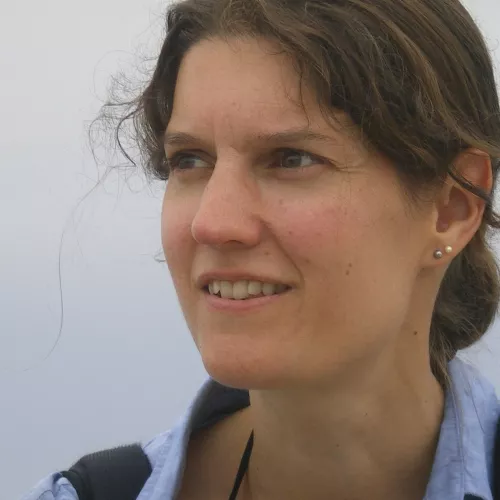
Dr Kirstin Gwyer
Biography
I completed my BA, MSt, and DPhil at the University of Oxford, where I graduated in 2009 with a thesis on German Jewish post-Holocaust literature. Since then, I have held a Junior Research Fellowship at Merton and lectureships at several Oxford colleges before joining Exeter in 2022. I am also responsible for German students at Merton and Pembroke.
Research
My research operates at the intersection of Global Modernist literatures, post-Holocaust memory studies, comparative Jewish and diasporic Black literatures, and the humanities-sciences interface. Though a Germanist by training, I work across languages and disciplines and have recently completed a monograph on Global Modernisms after Kafka: From the Holocaust to Postcolonialism to a Posthuman Future, supported by The Leverhulme Trust. Currently, I am writing a guide to Kafka’s Strange Loops, and, together with Jeannette Oholi, co-editing A Companion to Contemporary Black German Literature. I have a special interest in how marginalized authors expose the mechanics of the dominant (racializing, colonial, anthropocentric) gaze and am developing a research programme investigating the collapse of observer-independence across literature and physics.
Teaching
I teach German-language literature from the eighteenth century to the present, with a special interest in Modernist, post-1945, and contemporary writing, and I cover a range of modern prescribed authors including Thomas Mann, Kafka, Ingeborg Bachmann, Grass, and Sebald. I am invested in intersecting canonical texts and frameworks with minoritized counter-narratives by authors who, for reasons of class, disability, ethnicity, gender identity, neurodivergence, race, religion, or sexual orientation are writing against the grain. I also teach translation from and into German. At graduate level, I offer DPhil and MSt supervision across global Modernist, exile, post-Holocaust, postmemory, and contemporary literature, as well as postcolonial and environmental writing, and I warmly welcome proposals with a comparative or theoretical focus.
Monographs
Global Modernisms after Kafka: From the Holocaust to Postcolonialism to a Posthuman Future (forthcoming)
Encrypting the Past: The German-Jewish Holocaust Novel of the First Generation (Oxford University Press, 2014)
Edited Volumes
with Jeannette Oholi, A Companion to Contemporary Black German Literature: Expanding Resonances (in preparation)
Selected Articles and Chapters
‘Mimicry and Marronage: Neo-Runaway Narratives after Kafka’, in Kafka Global, ed. by Carolin Duttlinger, Ian Ellison, and Barry Murnane (Camden House, 2027)
‘Secrecy and Self-Reflection in Günter Grass’s Fiction and Autofiction’, in A Companion to Günter Grass, ed. by Paul Leworthy and Julian Preece (Camden House, 2027)
‘Kafka’s Der Process: Case Closed – Trial Reopened’, Modern Language Review, 122.1 (2027), 74-102
‘“Bil sem most”: vzvratni inženiring Kafke’, translated into Slovenian by Tadej Troha, Problemi, 64.9-10 (2025)
‘The Runaway Metaphor: Figurations of Colonialism, Slavery, and Race Following Kafka’, Modern Language Review, 120.4 (2025), 445-68
‘In the Shadow of No Memories? The Role of Dementia in Contemporary Aftermath Writing’, in The Politics of Dementia: Forgetting and Remembering the Violent Past in Literature, Film and Graphic Narratives, ed. by Irmela Marei Krüger-Fürhoff, Nina Schmidt, and Sue Vice (De Gruyter, 2022), 17-37
‘Kafka and his Recursors: The Process of Post-Holocaust Authors’, in From the Enlightenment to Modernism: Three Centuries of German Literature – Essays for Ritchie Robertson, ed. by Carolin Duttlinger, Kevin Hilliard, and Charlie Louth (Legenda, 2021), 262-78
‘Planetarity in the Global? Modern Jewish Literature in English’, in Disseminating Jewish Literatures: Knowledge, Research, Curricula, ed. by Ruth Fine, Natasha Gordinsky, Kader Konuk, Claudia Olk, Galili Shahar, and Susanne Zepp (De Gruyter, 2020), 115-25
‘Gynter Grass bald anders: Taking the Self out of Autobiography in Grass’s Beim Häuten der Zwiebel’, Oxford German Studies, 48.3 (2019), 328-45
‘H. G. Adler’s “Grenzgängertum”: Trans-Border Travel between Enlightenment Epistemology and Modernist Representation’, in A Modernist in Exile: The International Reception of H. G. Adler, ed. by Lynn Wolff (Legenda, 2019), 62-78
‘Beyond Lateness? “Postmemory” and the Late(st) German-Language Family Novel’, New German Critique, 125 (2015), 137-53
‘“Schmerzensspuren der Geschichte(n)”: Memory and Intertextuality in H. G. Adler and W. G. Sebald’, in Memory, Witnessing, Poetics: H. G. Adler and W. G. Sebald, ed. by Helen Finch and Lynn Wolff (Camden House, 2014), 112-36
Dr Kirstin Gwyer
Biography
I completed my BA, MSt, and DPhil at the University of Oxford, where I graduated in 2009 with a thesis on German Jewish post-Holocaust literature. Since then, I have held a Junior Research Fellowship at Merton and lectureships at several Oxford colleges before joining Exeter in 2022. I am also responsible for German students at Merton and Pembroke.
Research
My research operates at the intersection of Global Modernist literatures, post-Holocaust memory studies, comparative Jewish and diasporic Black literatures, and the humanities-sciences interface. Though a Germanist by training, I work across languages and disciplines and have recently completed a monograph on Global Modernisms after Kafka: From the Holocaust to Postcolonialism to a Posthuman Future, supported by The Leverhulme Trust. Currently, I am writing a guide to Kafka’s Strange Loops, and, together with Jeannette Oholi, co-editing A Companion to Contemporary Black German Literature. I have a special interest in how marginalized authors expose the mechanics of the dominant (racializing, colonial, anthropocentric) gaze and am developing a research programme investigating the collapse of observer-independence across literature and physics.
Teaching
I teach German-language literature from the eighteenth century to the present, with a special interest in Modernist, post-1945, and contemporary writing, and I cover a range of modern prescribed authors including Thomas Mann, Kafka, Ingeborg Bachmann, Grass, and Sebald. I am invested in intersecting canonical texts and frameworks with minoritized counter-narratives by authors who, for reasons of class, disability, ethnicity, gender identity, neurodivergence, race, religion, or sexual orientation are writing against the grain. I also teach translation from and into German. At graduate level, I offer DPhil and MSt supervision across global Modernist, exile, post-Holocaust, postmemory, and contemporary literature, as well as postcolonial and environmental writing, and I warmly welcome proposals with a comparative or theoretical focus.
Monographs
Global Modernisms after Kafka: From the Holocaust to Postcolonialism to a Posthuman Future (forthcoming)
Encrypting the Past: The German-Jewish Holocaust Novel of the First Generation (Oxford University Press, 2014)
Edited Volumes
with Jeannette Oholi, A Companion to Contemporary Black German Literature: Expanding Resonances (in preparation)
Selected Articles and Chapters
‘Mimicry and Marronage: Neo-Runaway Narratives after Kafka’, in Kafka Global, ed. by Carolin Duttlinger, Ian Ellison, and Barry Murnane (Camden House, 2027)
‘Secrecy and Self-Reflection in Günter Grass’s Fiction and Autofiction’, in A Companion to Günter Grass, ed. by Paul Leworthy and Julian Preece (Camden House, 2027)
‘Kafka’s Der Process: Case Closed – Trial Reopened’, Modern Language Review, 122.1 (2027), 74-102
‘“Bil sem most”: vzvratni inženiring Kafke’, translated into Slovenian by Tadej Troha, Problemi, 64.9-10 (2025)
‘The Runaway Metaphor: Figurations of Colonialism, Slavery, and Race Following Kafka’, Modern Language Review, 120.4 (2025), 445-68
‘In the Shadow of No Memories? The Role of Dementia in Contemporary Aftermath Writing’, in The Politics of Dementia: Forgetting and Remembering the Violent Past in Literature, Film and Graphic Narratives, ed. by Irmela Marei Krüger-Fürhoff, Nina Schmidt, and Sue Vice (De Gruyter, 2022), 17-37
‘Kafka and his Recursors: The Process of Post-Holocaust Authors’, in From the Enlightenment to Modernism: Three Centuries of German Literature – Essays for Ritchie Robertson, ed. by Carolin Duttlinger, Kevin Hilliard, and Charlie Louth (Legenda, 2021), 262-78
‘Planetarity in the Global? Modern Jewish Literature in English’, in Disseminating Jewish Literatures: Knowledge, Research, Curricula, ed. by Ruth Fine, Natasha Gordinsky, Kader Konuk, Claudia Olk, Galili Shahar, and Susanne Zepp (De Gruyter, 2020), 115-25
‘Gynter Grass bald anders: Taking the Self out of Autobiography in Grass’s Beim Häuten der Zwiebel’, Oxford German Studies, 48.3 (2019), 328-45
‘H. G. Adler’s “Grenzgängertum”: Trans-Border Travel between Enlightenment Epistemology and Modernist Representation’, in A Modernist in Exile: The International Reception of H. G. Adler, ed. by Lynn Wolff (Legenda, 2019), 62-78
‘Beyond Lateness? “Postmemory” and the Late(st) German-Language Family Novel’, New German Critique, 125 (2015), 137-53
‘“Schmerzensspuren der Geschichte(n)”: Memory and Intertextuality in H. G. Adler and W. G. Sebald’, in Memory, Witnessing, Poetics: H. G. Adler and W. G. Sebald, ed. by Helen Finch and Lynn Wolff (Camden House, 2014), 112-36