
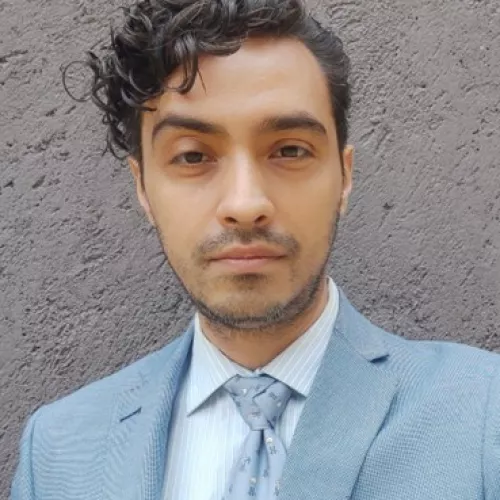
Dr. Hibraim Adán Pérez-Mendoza
I’m a Mexican biologist with a PhD in Ecology from UNAM. I always had an interest in ectothermic species biology and ecology (mainly amphibians and reptiles, but also some insects). During my undergrad studies I started working with mexican herpetofauna to understand their diversity spatial patterns and how the mexican states with higher diversity are part of the transition zone of the North America and South America’s biota. During my masters and PhD studies I started working with lizard demography and the evolutionary drivers that shape their temporal dynamics, testing on a single species the fast-slow continuum hypothesis. Currently, my research interests focus on life history evolution in ectotherms from different perspectives, primarily through the study of population dynamics, but also understanding the physiological and genetic constraints of species responses to a changing environment. Also I’m interested in understanding the challenges species may face under different climate change scenarios and if their current traits will allow them to persist or adapt to such changes. Pembroke college represents to me the opportunity to collaborate with outstanding academics and brilliant students in my research, I would love to teach about the evolutionary drivers of the current life history strategies that ectotherms have to cope with environmental conditions, and how such strategies have been shaped by the historical variability in the selective forces. Ectotherms are a particularly interesting group, as their energy expenditure is not constrained by maintaining body temperature and therefore, resource acquisition and allocation can widely differ from homeotherms (e.g. some snakes can lose more than 50% of their body weight after parturition, and for some caecilians is up to 80%). Also ectotherms have a wide array of reproductive modes (amphibians are the group of vertebrates with the higher number of reproductive modes) which makes them a great study group. Amphibians are the most threatened group and among vertebrates, and are also the group with highest developmental plasticity, a trait promising for future research on different venues due the relevance of the metamorphosis process. For understanding this plasticity, I’m using an experimental approach having tadpoles under captivity under different temperature and desiccation conditions (those expected due to climate change) to study if they can or cannot accelerate development, the morphological consequences for froglets of such accelerated development (when it happens), and the genes involved in metamorphosis (using transcriptomic analysis) and looking specifically if the responses under the different treatments show the over or underexpression of the same genes. Finally, I’m also working with species distribution modeling for invasive and native ant species in Mexico, using their transcriptomic profiles to understand the role of environmental variability in gene expression looking for genes associated with the ability to colonize and become invasive.
Dr. Hibraim Adán Pérez-Mendoza
I’m a Mexican biologist with a PhD in Ecology from UNAM. I always had an interest in ectothermic species biology and ecology (mainly amphibians and reptiles, but also some insects). During my undergrad studies I started working with mexican herpetofauna to understand their diversity spatial patterns and how the mexican states with higher diversity are part of the transition zone of the North America and South America’s biota. During my masters and PhD studies I started working with lizard demography and the evolutionary drivers that shape their temporal dynamics, testing on a single species the fast-slow continuum hypothesis. Currently, my research interests focus on life history evolution in ectotherms from different perspectives, primarily through the study of population dynamics, but also understanding the physiological and genetic constraints of species responses to a changing environment. Also I’m interested in understanding the challenges species may face under different climate change scenarios and if their current traits will allow them to persist or adapt to such changes. Pembroke college represents to me the opportunity to collaborate with outstanding academics and brilliant students in my research, I would love to teach about the evolutionary drivers of the current life history strategies that ectotherms have to cope with environmental conditions, and how such strategies have been shaped by the historical variability in the selective forces. Ectotherms are a particularly interesting group, as their energy expenditure is not constrained by maintaining body temperature and therefore, resource acquisition and allocation can widely differ from homeotherms (e.g. some snakes can lose more than 50% of their body weight after parturition, and for some caecilians is up to 80%). Also ectotherms have a wide array of reproductive modes (amphibians are the group of vertebrates with the higher number of reproductive modes) which makes them a great study group. Amphibians are the most threatened group and among vertebrates, and are also the group with highest developmental plasticity, a trait promising for future research on different venues due the relevance of the metamorphosis process. For understanding this plasticity, I’m using an experimental approach having tadpoles under captivity under different temperature and desiccation conditions (those expected due to climate change) to study if they can or cannot accelerate development, the morphological consequences for froglets of such accelerated development (when it happens), and the genes involved in metamorphosis (using transcriptomic analysis) and looking specifically if the responses under the different treatments show the over or underexpression of the same genes. Finally, I’m also working with species distribution modeling for invasive and native ant species in Mexico, using their transcriptomic profiles to understand the role of environmental variability in gene expression looking for genes associated with the ability to colonize and become invasive.